


What Is an IRS 1099 Form?
A 1099 is what the IRS calls an "information return." Unlike a W-2 that covers wages from an employer who withholds taxes from every paycheck, a 1099 documents income where taxes haven't been taken out yet.
When a business pays you as a contractor, a bank sends you interest from a savings account, or an investment firm distributes dividends from your portfolio, they report that payment to the IRS and send you a copy, using the right type of IRS 1099 Form.
The IRS uses these forms to match up what people and businesses report earning with what payers report paying. If you receive a 1099, the IRS gets one too, which is why understanding what each type means helps you avoid mismatches that can trigger questions later. For businesses that hire contractors or make certain payments, issuing 1099s isn't optional. It's a legal requirement with specific deadlines and dollar thresholds you need to know.
The Most Common Types of 1099 Forms

There are ten more types of IRS 1099 forms, and each of them is used for different purposes.
You May Also Like: All about W-9 Form: What It Is, What It Is Used for, and How to Fill It Out >>
1099-NEC — Nonemployee Compensation
If you work as a freelancer, independent contractor, or gig worker, this is the form you'll see most often. A 1099-NEC Form reports what a client paid you when you earned $600 or more from them during the year. The "NEC" part stands for Nonemployee Compensation, and the key thing to know is that no taxes were withheld from these payments—you're responsible for reporting this income and paying the taxes on it yourself.
For businesses, you generally need to issue a 1099-NEC to any independent contractor you paid $600 or more during the tax year. This includes individuals, partnerships, and LLCs, though payments to most corporations are exempt. The deadline to get these forms to recipients is January 31, which is earlier than some other 1099 types.
1099-MISC — Miscellaneous Income
The 1099-MISC Form catches payments that don't fit neatly into the other categories. If your business paid rent for office space, sent royalty payments to an author, or awarded a prize in a contest, those amounts get reported here. The thresholds vary—at least $10 in royalties or $600 in rent triggers the requirement to issue this form.
1099-INT — Interest Income
Banks, credit unions, and other financial institutions send out a 1099-INT Form when you earn more than $10 in interest during the year from a savings account, CD, or money market account. Even if you earn less than that and never see the form, the interest is still technically taxable income you should report.
1099-DIV — Dividend Income
If you own stocks, mutual funds, or other investments that pay dividends, your brokerage or investment company will send you a 1099-DIV Form. This form breaks down what you received into ordinary dividends and qualified dividends—the distinction matters because they're taxed at different rates. The form also reports any capital gain distributions the fund made during the year.
1099-B — Broker and Barter Exchange Transactions
Whenever you sell stocks, bonds, options, or other securities through a broker, that transaction appears on a 1099-B. The form shows your proceeds from the sale, the cost basis if your broker has that information, and whether the gain or loss is short-term or long-term. You use these details to complete Schedule D when you file your taxes.
1099-K — Payment Card and Third-Party Network Transactions
The 1099-K reports payments you received through credit cards, debit cards, or platforms like PayPal, Venmo, and Cash App. The IRS has been adjusting the reporting threshold for this form in recent years, which means more people are receiving it than before. It reports the total dollar amount processed through these channels, not your net profit after expenses.
1099-R — Retirement Distributions
When you take money out of a 401(k), IRA, pension, or annuity, the distribution gets reported on a 1099-R. The form shows how much was distributed and how much was withheld for taxes. Not every retirement distribution is taxable, and the form includes codes that help you and your tax preparer figure out which part applies.
1099-G — Government Payments
State and local governments use the 1099-G to report unemployment compensation they paid you, state tax refunds you received, and other government payments. If you collected unemployment benefits during the year, the total appears on this form and is generally taxable at the federal level.
Who Needs to File a 1099 Form?
The filing responsibility falls on the payer, not the recipient. If you run a business and make certain types of payments during the year, you need to send 1099s to the people and businesses you paid. For 1099 independent contractor payments, the threshold is $600 or more for services during the tax year. The same $600 threshold applies to rent payments. For royalties, the trigger is just $10.
The question of who needs to file a 1099 comes up most often around contractors. If you paid an individual, partnership, or LLC $600 or more for work they did for your business, you generally need to send them a 1099-NEC. Payments to corporations are usually exempt, though law firms are a notable exception—you send them a 1099 regardless of how they're structured.
Deadlines matter, and missing them can get expensive. The 1099 deadline for getting 1099-NEC forms to recipients is January 31. Other 1099 types are also due to recipients by January 31, with copies to the IRS due by February 28 if you file on paper or March 31 if you file electronically. If these dates land on a weekend or holiday, they shift to the next business day.
1099 vs. W-2: What's the Difference?
The main difference between a 1099 and a W-2 comes down to the relationship between the payer and the person getting paid.
-
A W-2 goes to employees, people whose employer withholds income tax, Social Security, and Medicare from every paycheck.
-
A 1099 goes to non-employees, such as independent contractors and freelancers, whose taxes aren't withheld at the source.
This distinction has real financial implications. If you receive a 1099, no taxes have been taken out of that income yet. You're responsible for paying both the employee and employer shares of Social Security and Medicare taxes, called self-employment tax, which adds up to 15.3% on top of your regular income tax. This is why many freelancers make quarterly estimated tax payments throughout the year, so they don't face one large bill when they file.
Fill Out the IRS 1099 Form (1099-MISC)
To fill out an IRS 1099 form, the first and foremost step you need to do is to get the form template from the IRS official website. A 1099 form contains five copies of one form, including copy A appears in red which is designed for the IRS, copy B and other copies all appear in black and copy 1 is for the state tax department (if needed), copy B and copy 2 are kept by the recipient, copy C is for your own records. In addition, copy A cannot be printed or downloaded offline while other copies don’t have such restrictions.
Before you touch the form, you need your business name, address, and Taxpayer Identification Number, plus the same details for each person or business you paid. For contractors, collecting a Form W-9 before you make the first payment is the easiest way to have everything ready at year-end.
Most contractor payments go on a 1099-NEC. Rent and royalties go on a 1099-MISC. Interest and dividends go on their own respective forms. Using the wrong one creates confusion for both the recipient and the IRS.
Here’s how to fill out a 1099-MISC form:
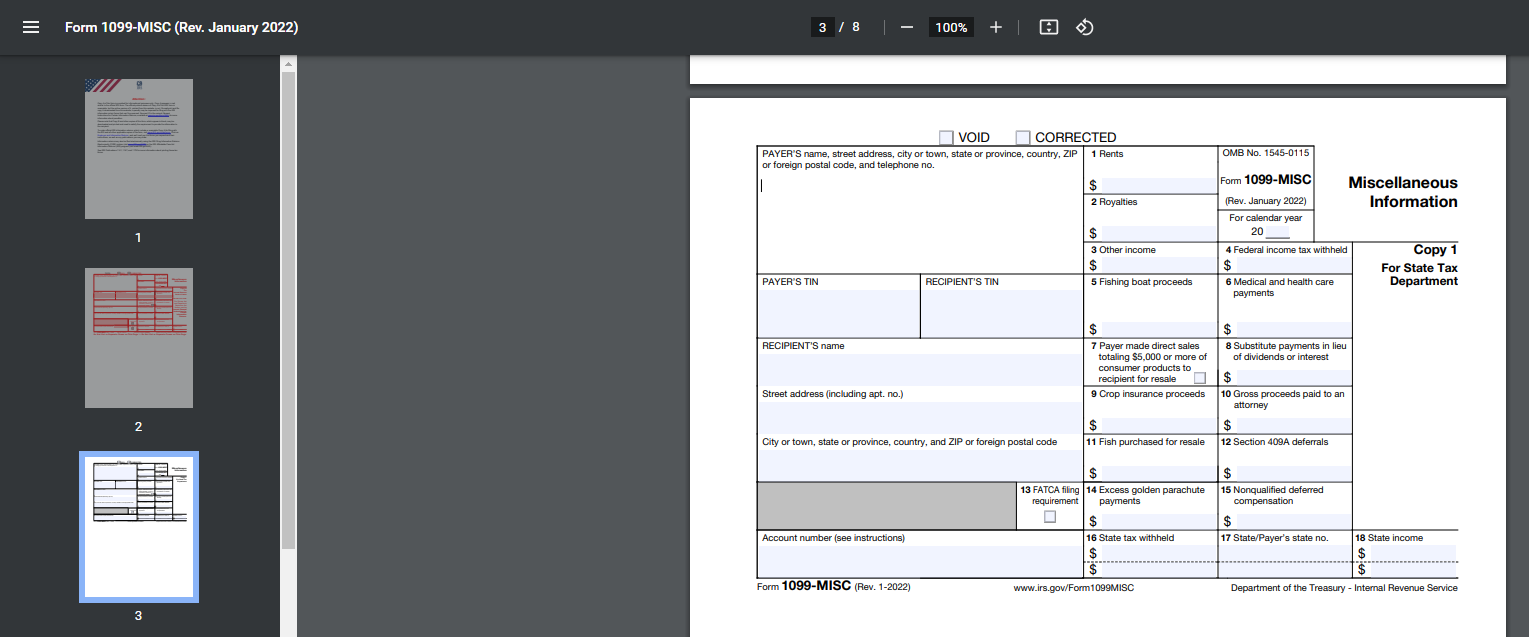
Step 1. Obtain the correct 1099 form
Determine which 1099 form you require based on the type of income you are reporting. For example, if you're reporting income from freelance work, you'll need a 1099-MISC form.
Step 2. Gather necessary information
Collect all the required information for both yourself (the payer) and the recipient of the payment (the payee). Names, addresses, and taxpayer identification numbers (TINs) or Social Security numbers (SSNs) are all included.
Step 3. Enter the payer's information
In the Payer's Information section of the form, enter your name, address, and TIN or SSN.
Step 4. Fill out recipient information
In the Recipient's Information section, enter the payee's name, address, and TIN or SSN. If the payee is a business entity, you may need to use their Employer Identification Number (EIN).
Step 5. Provide payment details
Report the payment amount made to the recipient during the tax year in the appropriate boxes.
Step 6. Report federal income tax withheld (if applicable)
If you withheld federal income tax from the recipient's payment, enter the amount withheld in Box 4. This is common for certain types of income, such as backup withholding.
Step 7. Fill out state tax withholding (if applicable)
If you withheld state income tax from the payment, enter the withheld amount in the state tax withholding box, if provided.
Step 8. Fill out any additional information that is requested
Depending on the specific 1099 form you're using, there may be additional boxes or sections that require information related to the type of income being reported. Fill out these sections as necessary.
Step 9. Review and validate the form
Examine all of the information you've entered to ensure its accuracy. When it comes to filing taxes, mistakes or missing information can cause problems for both you and the recipient.
Step 10. Distribute copies
Make copies of the completed 1099 form for your records, as well as for the recipient. Provide the recipient with their copy by the deadline specified by the IRS (generally by January 31st).
Step 11. File the form with the IRS
Depending on the volume of forms you're filing, you may need to file them electronically or mail paper copies to the IRS. Check the IRS instructions for the specific filing requirements and deadlines.
Remember to stay up to date on the most recent IRS guidelines and instructions for filling out and submitting 1099 forms, as they may change over time. If you have any questions about the process, consult with a tax professional or use tax software to ensure accurate and timely filing.
How to Manage 1099 Forms as PDFs?
Whether you've downloaded a 1099 Form PDF from the IRS website or received one that needs your attention, working with these documents digitally saves you from the print-fill-scan cycle that eats up time during tax season.
SwifDoo PDF is free and runs on Windows, Mac, iOS, and Android. Download it at swifdoo.com to fill out, sign, and manage your tax forms without printing, scanning, or uploading sensitive documents anywhere.
You can open any 1099 form directly in SwifDoo PDF and type into the fields, whether it's an interactive form with fillable boxes or a flat PDF where you need to add text manually. If you make a mistake, you can fix it right in the document instead of starting over.
The Signature tool lets you add your signature by drawing it with your mouse, typing your name, or uploading an image of your actual signature. For forms with personal information like TINs and addresses, you can add password protection before sending them through email.
And if the file size is too large to attach, the compression tool brings it down while keeping everything readable.
SwifDoo PDF is a Windows-based PDF editor with comprehensive features to help you edit, convert, compress, protect, and print PDF files hassle-free. When requiring printing 1099 forms in color, print them with multiple copies in one shot, or print all forms in one sheet, SwifDoo PDF makes the process simple and easy to follow. Let’s see the specific steps:
Step 1. Free download and install SwifDoo PDF on your PC.
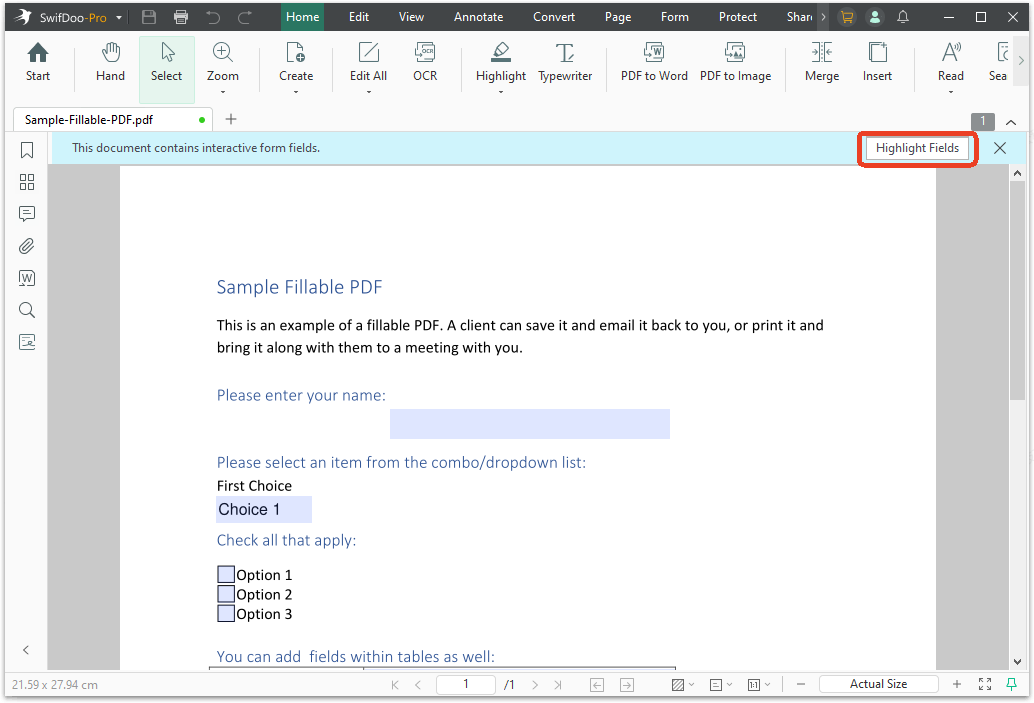
Step 2. Open your 1099 form in this program and SwifDoo PDF automatically finds any fillable fields in the document. Click on the Highlight Fields button.
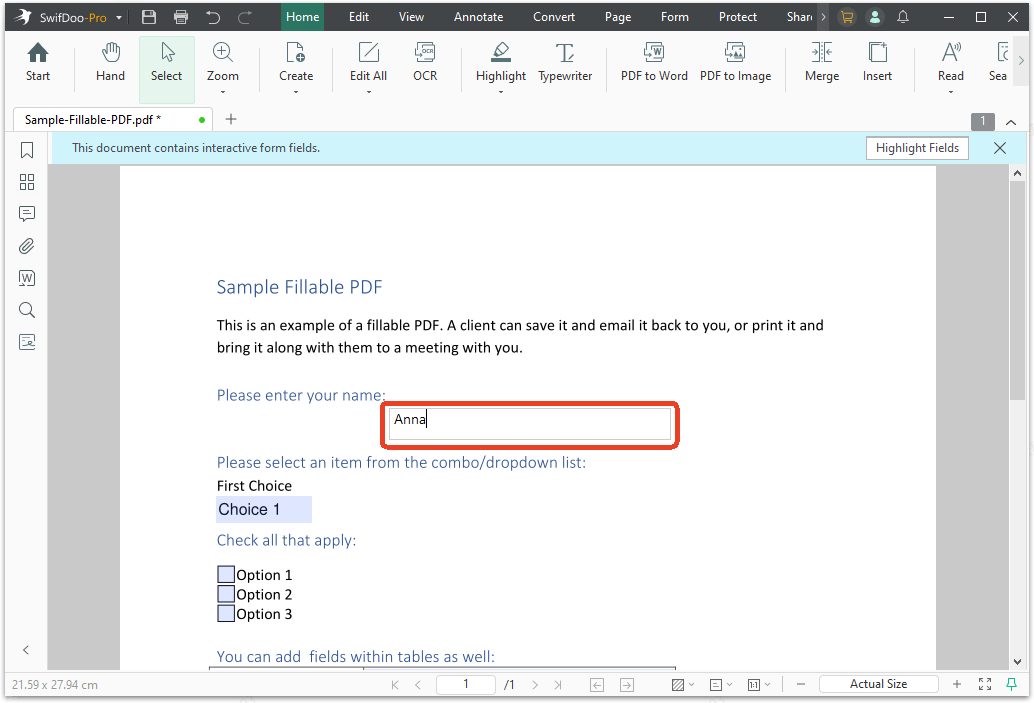
Step 3. Click on the highlighted area and you can type on the PDF form.
Step 4. Tap Save when you finish.

10 Best PDF Translators That You Must Know in 2026
Check this post to find out the 10 best PDF translators in 2025. We've tested and selected them from different aspects to help you translate your PDF documents.
READ MORE >The Bottom Line
After reading this post, you’ll have a comprehensive knowledge about the IRS 1099 form. In this article, we’ve thoroughly explained what 1099 forms are, what are they used for, how to fill out a 1099 form, and many other helpful information of this form. In addition, a handy PDF printer called SwifDoo PDF is also introduced for you to easily print 1099 forms. Don't forget to download it and give it a try!