What Is Mistral AI
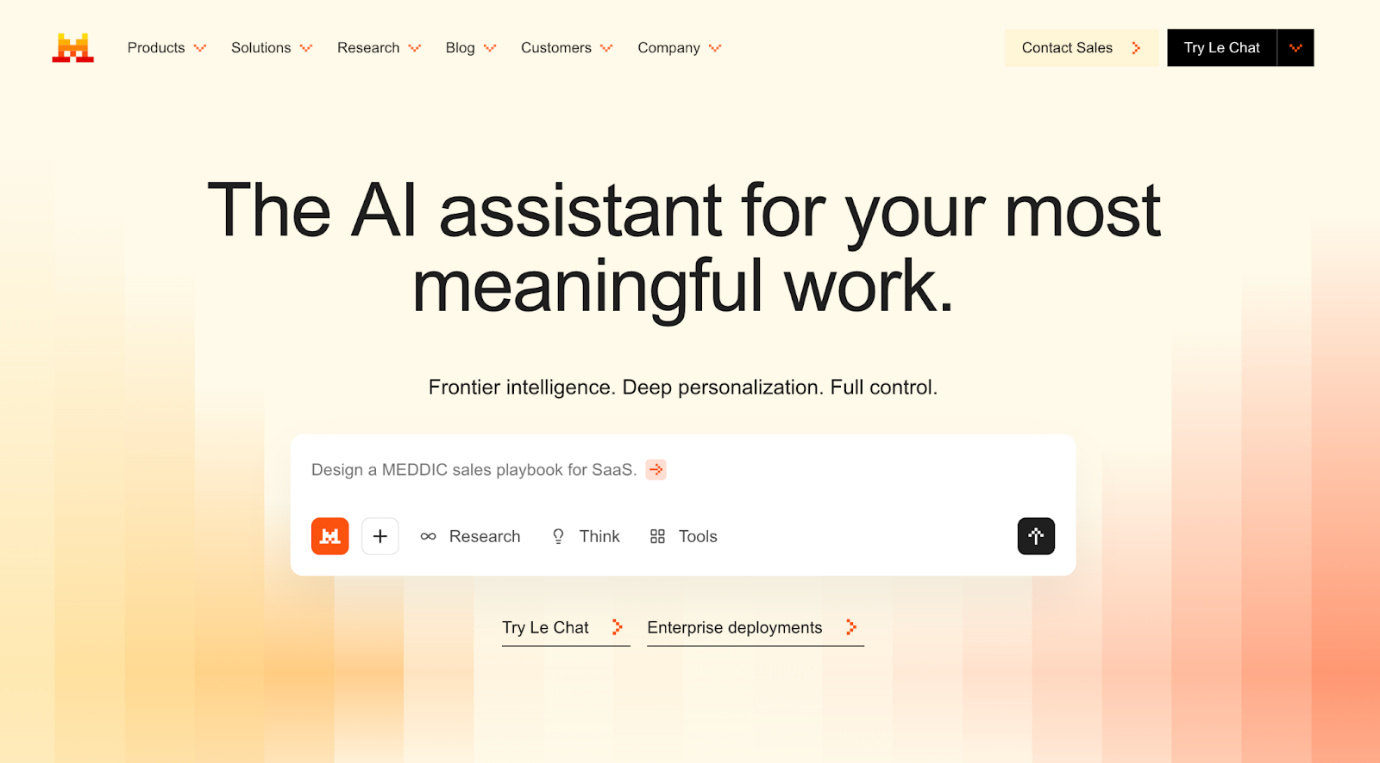
Founded in 2023, Mistral AI is a French AI company creating advanced large language models for developers and businesses. Its emphasis on open-weight models allows users to utilize, adjust, and deploy the AI independently.
Its efficient architecture enables powerful performance with less computational overhead. This allows quicker responses, improved scalability, and versatile deployment across platforms and environments.
Popular Mistral AI Models
Prior to examining individual models, it helps to understand that Mistral AI offers multiple language models designed for various tasks and performance capabilities. The focus of these models is on strong reasoning, scalability, and efficient performance.
The company offers both open-weight and commercial models for developers to use in various AI applications.
Below is a list of Mistral AI’s most widely used models.
- Mistral 7B. A lightweight open-weight language model with 7 billion parameters designed for strong performance and efficiency. It is widely used for chatbots, text generation, and reasoning tasks while requiring fewer computing resources.
- Mixtral 8x7B. A powerful Mixture-of-Experts model that activates only a subset of its parameters during inference. This architecture improves efficiency and delivers robust results in coding, reasoning, and multilingual work.
- Mistral Large. A powerful model built for advanced reasoning, multilingual comprehension, and enterprise-grade applications. It supports long context windows and advanced AI capabilities.
- Codestral. A model specialized in coding, handling code generation, debugging, and completion across multiple programming languages, ideal for developers.
These models are frequently used for chatbots, coding assistance, quality content generation, and enterprise AI solutions.
Key Advantages of Mistral AI
- Open-weight access. Mistral AI offers open-weight models, enabling developers and businesses to access, customize, and deploy them on their own infrastructure. It enables tailored solutions, enhanced data privacy, and full control of AI performance.
- Efficient architecture. Built on efficient transformer designs, the models incorporate Mixture-of-Experts and sliding-window attention techniques. This design ensures high performance while reducing computational costs and improving response speed.
- High scalability. Mistral AI models scale effortlessly across cloud, enterprise servers, and edge devices, making them ideal for both small projects and large applications.
- Versatile applications. These models are suitable for chatbots, content creation, coding help, multilingual understanding, and enterprise AI, offering adaptability for multiple sectors.
- Strong performance. Though some versions are lightweight, Mistral AI models offer competitive reasoning and accuracy, rivaling bigger models with lower resource use.
What Is ChatGPT
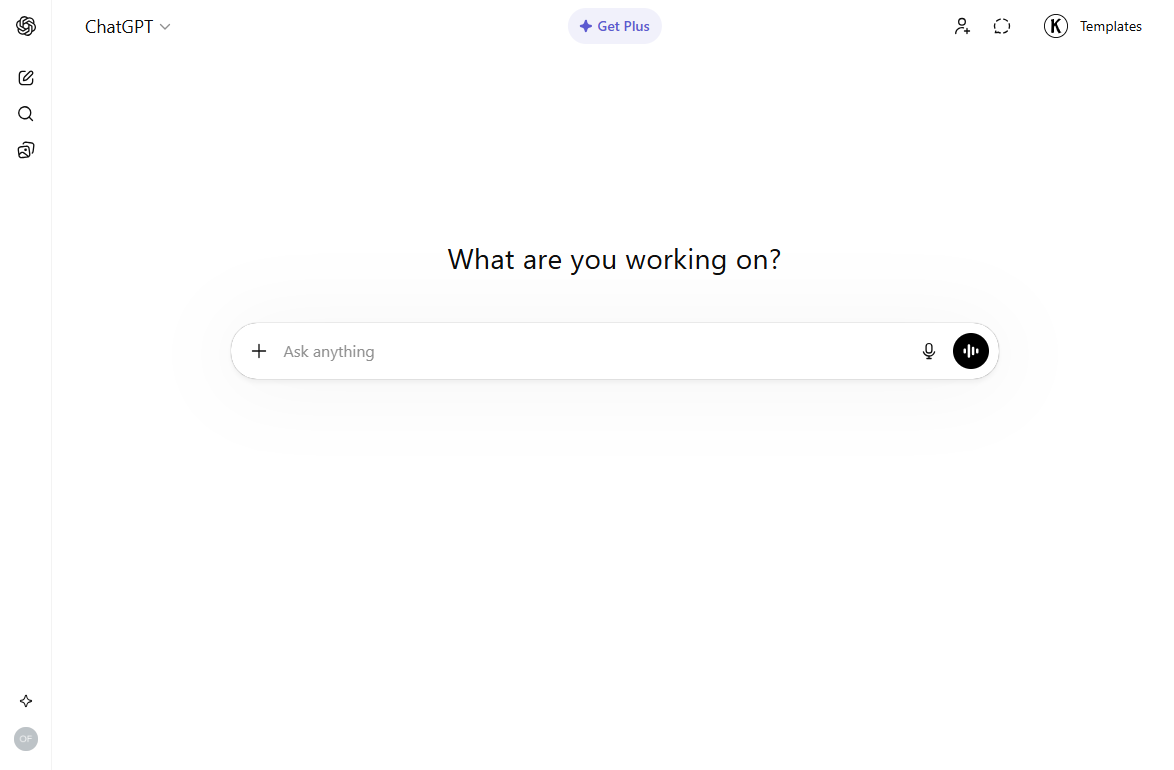
ChatGPT is a powerful AI language model from OpenAI, built to understand and produce human-like text across various tasks. It aids in writing, generating ideas, coding, and customer support, making it adaptable for both personal and professional applications. You can analyze PDFs with ChatGPT to efficiently summarize content, extract key insights, and answer questions from your documents.
ChatGPT Models
ChatGPT functions using multiple advanced language models developed by OpenAI, including:
- GPT-4
- GPT-4o
- GPT-4 Turbo
Those models support advanced features and are designed to deliver advanced AI capabilities, such as:
- Natural language understanding and highly accurate text generation.
- Multimodal capabilities for text and images.
- Understand complex queries.
- Long-context processing for large documents.
- Support a variety of applications from content creation to coding assistance.
Key Advantages of ChatGPT
- Ease of use. ChatGPT provides a user-friendly interface that lets people interact with AI naturally without requiring technical knowledge. Its conversational style makes it simple to ask questions, create content, or quickly receive help with tasks.
- Versatility across tasks. It can handle a wide range of applications, including content creation, coding, data analysis, language translation, and customer support, making it a multifunctional AI assistant.
- Advanced comprehension and generation. Built on GPT-4, GPT-4o, and GPT-4 Turbo, ChatGPT processes complex queries, creates high-quality content, and maintains context during extended conversations.
- PDF and document analysis. Users can analyze PDFs with ChatGPT to quickly extract insights, summarize content, and answer questions from documents, enhancing productivity.
- Multimodal capabilities. With text and image support, ChatGPT processes different input formats, allowing more interactive experiences and expanded applications.
Mistral AI vs ChatGPT: Key Differences
In the comparison of Mistral AI vs ChatGPT, both deliver powerful AI features yet vary in design focus, accessibility, and use cases. Mistral AI is built around open-weight models and efficient architecture for flexible deployment, while ChatGPT delivers a polished experience with multimodal and long-context capabilities.
The table below offers a quick look at how they vary across key features.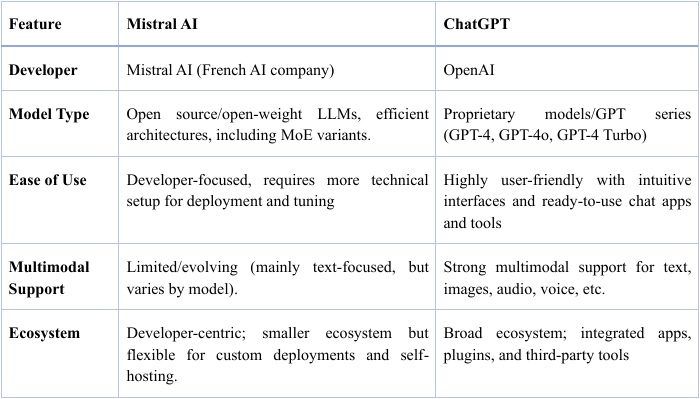
Mistral AI vs ChatGPT Performance Comparison
With the comparison done, let us look at how Mistral AI vs ChatGPT perform in their main capabilities. Both are powerful, but their strengths differ according to architecture, training data, and design approach.
This section breaks down how they compare in terms of language understanding, reasoning, response quality, and performance efficiency.
Language Understanding
Mistral AI models are trained to interpret and generate text with solid contextual awareness, especially in open‑weight settings that can be fine‑tuned for specific domains.
However, the GPT-series models behind ChatGPT usually have broader datasets and excel at nuanced language, making them more dependable for complex queries.
Reasoning Ability
When it comes to reasoning, ChatGPT often demonstrates stronger logical coherence and multi‑step problem-solving due to its larger and more deeply trained architectures. Mistral AI performs well on reasoning, yet ChatGPT’s models generally manage intricate reasoning more reliably and efficiently.
Response Quality
Responses from ChatGPT are generally well-organized and refined, delivering clear explanations and better managing complex material. On the flip side, Mistral AI offers robust, efficient outputs suitable for demanding tasks. Nevertheless, extra prompting may be necessary to reach the same level of clarity and polish as ChatGPT.
Speed and Efficiency
Mistral AI typically excels in speed and compute efficiency, using open-weight models and optimized architectures to deliver fast inference. ChatGPT delivers reliable performance but may slow in resource-demanding situations, especially for very lengthy or complex tasks.
Mistral AI vs ChatGPT for Different Use Cases
Here’s how Mistral AI vs ChatGPT stack up for different use cases, making it easier to pick the right tool.
Mistral AI vs ChatGPT for Coding
ChatGPT performs exceptionally well in routine coding tasks, giving clear guidance, debugging support, and multi-language assistance, making it suitable for developers and learners alike.
Mistral AI shines in customizable deployments, letting developers integrate and fine-tune models for specific coding workflows, enterprise pipelines, or specialized tasks, providing greater control and efficiency.
To sum up, ChatGPT is more suited for routine coding tasks, while Mistral AI excels in customized developer deployments.
Mistral AI vs ChatGPT for Content Writing
ChatGPT usually provides high-quality, contextually aware content, with excellent structure and tone control for blog posts, marketing content, and storytelling.
Mistral AI can generate high‑quality text, too, but may require additional fine‑tuning or prompt engineering for consistent style and depth.
To summarize, ChatGPT excels at immediate content creation, whereas Mistral AI is better for tailored writing solutions with specialized tuning.
Mistral AI vs ChatGPT for Business
For business applications, ChatGPT delivers ready-made features, plugins, and integrations that aid customer support, analytics, and internal productivity.
Mistral AI excels with customizable models that enterprises can host and fine-tune on domain-specific data, emphasizing control and privacy.
In summary, ChatGPT is ideal for businesses seeking quick, plug-and-play AI solutions, while Mistral AI is better for enterprises that need fully customizable, secure, and domain-specific AI deployments.
Mistral AI vs ChatGPT Pricing
When it comes to Mistral AI vs ChatGPT pricing, Mistral AI often offers open‑weight models that can be accessed freely or deployed at lower infrastructure cost, though enterprise support and hosting expenses may vary.
Mistral's free Le Chat tier offers generous daily limits. Many users never need to upgrade - you can have lengthy conversations without hitting restrictions. Le Chat Pro costs US$15 per month, removing all limits and adding access to their most advanced models. It costs less than ChatGPT Plus while offering similar features.
ChatGPT pricing usually involves subscription tiers (like Plus or Team plans) and API usage costs based on tokens or compute units, which can add up with heavy use. The free version gives you access to GPT-5 with daily message limits. Once you hit the limit, you wait until the next day or upgrade.ChatGPT Plus costs US$20 per month.
Summary. Mistral AI is generally more flexible and cost‑efficient for custom deployments, while ChatGPT provides straightforward, tiered pricing that’s easier to plan for regular users and businesses.
Mistral AI vs ChatGPT: Open Source vs Proprietary
Mistral AI emphasizes openness by offering open‑weight models that developers can access, inspect, and modify for their own use cases. This open approach encourages transparency, customization, and community contributions, letting technical teams adapt models to their needs without strict licensing.
By contrast, ChatGPT relies on proprietary models from OpenAI, so the underlying weights and training details are not publicly accessible. While direct customization is limited, it provides a refined, maintained product with integrated optimizations, safety measures, and services backed by OpenAI updates.
Summary. Mistral AI’s open-weight models give developers and enterprises flexibility and control, whereas ChatGPT’s proprietary models offer a managed, reliable experience with less technical effort for everyday users.
ChatGPT vs Mistral AI: Pros and Cons
Here’s a clear comparison of the pros and cons of ChatGPT vs Mistral AI to show their strengths and shortcomings. Looking at each tool’s pros and cons helps you determine which AI assistant is best for personal use, development tasks, or enterprise deployment.
ChatGPT Pros and Cons
Pros:
- Skilled at interpreting user intent and delivering coherent responses during conversations.
- Highly versatile with superior reasoning and creative capabilities (GPT-5/4o).
- With a broad grasp of many subjects, it’s useful for general research, writing, tutoring, and idea generation.
- Works well for creative writing, code generation, summarization, language translation, and detailed explanations.
- Intuitive to use, preserving context across multi-turn conversations with easy prompts.
- Integrates with apps, APIs, and extensions, offering additional tools for tasks such as web search, translation, and code environments.
- Supports structured outputs—such as lists, tables, and code—enhancing readability and usefulness.
- Excellent multimodal (text, voice, image) integration.
Cons:
- May produce incorrect or fabricated information if the prompt is unclear or the model lacks confidence.
- Data passes through OpenAI servers, raising privacy concerns.
- Built on training data with cutoffs, it may miss very recent developments or uncommon facts.
- Doesn’t allow training on proprietary data unless enterprise features are used.
- Costs more for advanced features (e.g., Plus subscription).
- Gives thorough responses, which is great for depth but less suitable when brevity is preferred.
Mistral AI Pros and Cons
Pros:
- Some Mistral models are designed to be competitive on benchmarks for logic, reasoning, and code generation.
- Open-weight models provide complete control over deployment and data, enhancing privacy.
- Optimized to run faster while offering a higher performance-to-size ratio than similar models.
- Can be fine‑tuned or adapted for specific tasks like summarization, Q&A, or automated workflows.
- Cheaper Pro plan and known for high speed and efficient performance.
- Mistral’s open model is particularly attractive to developers and researchers looking for customization options.
- Optimized, compact models can deliver quicker performance and lower deployment costs for applications and services.
Cons:
- While strong technically, some versions may not maintain conversational continuity as smoothly as ChatGPT.
- Less polished "Le Chat" interface, fewer third-party integrations.
- Fewer ready‑made plugins, integrations, and products built around it (compared to ChatGPT’s ecosystem).
- Not all Mistral models are equally capable — quality can differ depending on which variant you use.
- Less capable of handling complex, long-context reasoning compared to GPT-5.
- The scope of information depends on the training data; some deployments may lag in up‑to‑date coverage.
Bonus: How to Use AI to Simplify Your PDF Workflow
While Mistral AI and ChatGPT excel in many areas, they have general disadvantages, such as occasional inaccuracies, limited up-to-date knowledge, and reduced efficiency in handling document-specific tasks. Instead, try an AI-powered PDF editor such as SwifDoo PDF to make editing, annotating, and managing PDFs faster and smarter.
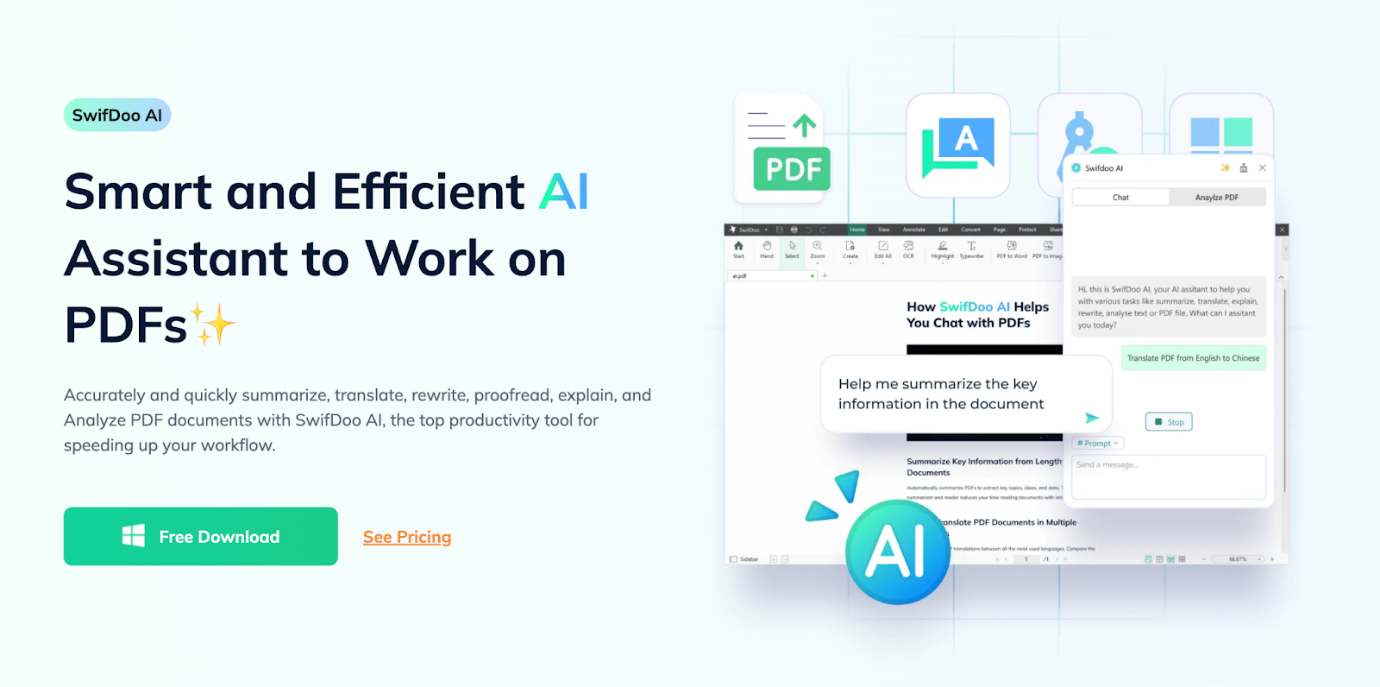
For smooth PDF handling, SwifDoo PDF is a solid choice. SwifDoo AI helps automate routine tasks and improve productivity. It also lets you translate PDFs effortlessly, simplifying the handling of multilingual documents. Furthermore, the easy-to-use interface helps you edit, annotate, and organize PDFs efficiently for personal or work purposes.
Final Verdict
When deciding between Mistral AI vs ChatGPT, it ultimately depends on your priorities. If you want a powerful, ready-to-use AI chatbot with smooth conversational abilities and broad knowledge, ChatGPT is usually the better option. On the other hand, if you value flexibility, customization, and the ability to deploy AI models in your own workflows, Mistral AI may be the better choice. In the end, both have strong points, so assess your needs and workflow to select the most suitable between Mistral AI and ChatGPT.