

Why Are Strong Passwords Important?
Despite advances in biometrics and the rise of passkeys, passwords are still the main way to secure digital accounts. Weak passwords are like leaving your front door unlocked.
Why strong passwords are more important than ever: Almost every part of our lives—email, cloud storage, health records, and entertainment—is online. To stay secure, you must create strong passwords that protect your accounts from hackers and identity thieves. Weak passwords make it easy for cybercriminals to steal personal information or access sensitive data.
Strong, unique passwords help safeguard your accounts, finances, and digital identity. They are especially important for critical services such as banking, medical portals, and workplace tools, where one weak password can cause major problems.
Discovering how to create strong passwords allows you to secure your digital life and avoid unnecessary risks.
Weak Passwords Vs Strong Passwords
A password’s security is determined by more than length; complexity and resistance to cracking tools are crucial
#Weak Password
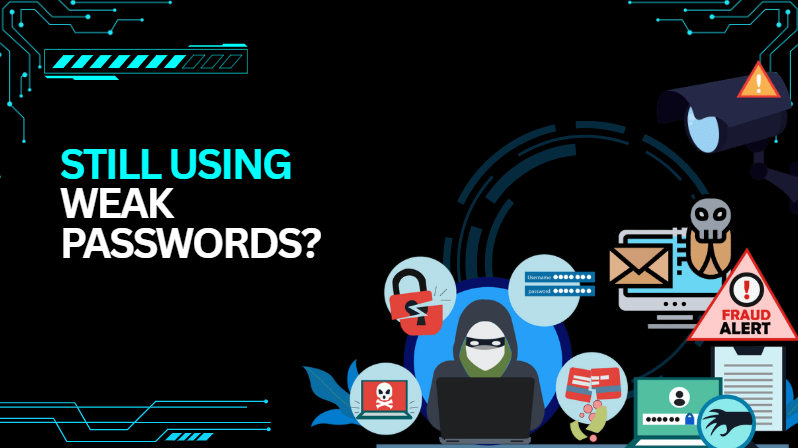
- Short passwords are weak. Typically under 12 characters, making them quick to brute-force.
- Based on personal information. Using your name, birthday, pet’s name, or anniversaries.
- Common words or patterns. Typical weak passwords include “password,” “123456,” “qwerty,” and sequential repeats.
- Used on more than one account. Using the same password on multiple sites puts all your accounts at risk if one is hacked.
- Dictionary-based. Words found in standard dictionaries are predictable and easy to crack.
- Weak password cracking time. From a few seconds to several minutes. They provide very little protection against hackers.
#Strong Password
 Strong passwords are designed to resist guessing and automated attacks. They have these key traits.
- Long and complex. Minimum 14–16 characters, with 20+ preferred.
- Unique and highly resistant to hacking. Use a mix of random characters or well-constructed passphrases.
- No personal info or dictionary words. Don’t include personal information or obvious words.
- Never reused. Each account should have its own unique password.
- No common patterns or substitutions. Avoid predictable replacements like “P@ssw0rd.”
- Extra security. Enable multi-factor authentication whenever you can.
- Stay protected. Store your passwords in a trusted password manager.
Crack time for strong passwords is much longer, greatly improving your online security and making it very difficult for attackers to gain access.
How to Create a Strong Password - Important Tips and Techniques
Creating passwords today centers on entropy, the metric for unpredictability. A high-entropy password is long, random, and avoids predictable sequences. The following methods help you achieve it:
- Prioritize Length Over Complexity
Prioritize password length over symbol complexity. A 16-character passphrase provides far greater security than a short, symbol-heavy password. - Use the Passphrase Method
Use 4–5 random, unrelated words to make passwords easy to remember. This produces a password that’s long, easy to remember, and difficult to crack. For instance: correct-horse-battery-staple; purple-jazz-ocean-tiger. - Let a Machine Do the Heavy Lifting
For most accounts, let a password manager generate fully random passwords. It delivers top-level entropy with no memorization needed. - Always Enable Multi-Factor Authentication (MFA)
Strong passwords protect your accounts, but MFA adds another critical layer. If your password is compromised, an attacker still won’t have your second factor, like a one-time code from an authenticator app.
Step-by-Step Guide to Create a Strong Password
A strong password is one of the simplest and most effective ways to secure your online accounts. Use this step-by-step guide to build passwords that are long, unique, and hard to guess. A simple formula works reliably: Long + Unique + Slightly Unpredictable.
Step 1. Begin with an extended passphrase.
Choose four unrelated words to form a strong base.
Example. mountain-pencil-sunset-comet.
Step 2. Add a small, unpredictable element.
Include a symbol, number, or uppercase letter to increase complexity.
Example. mountain-pencil_Sunset-Comet9.
Step 3. Skip personal data and easily guessable patterns.
Skip predictable elements like birthdays, pet names, keyboard sequences, or substitutions.
Step 4. Never reuse passwords.
Using identical passwords across accounts greatly increases your risk of being hacked.
Step 5. Add spaces, punctuation, or symbols to increase entropy.
Even small changes make passwords far harder for automated cracking tools.
Final structure.
Use a 4-word passphrase, add a small change, and customize per account.
Common Mistakes to Avoid When Creating Passwords
People still make basic errors that endanger their accounts. Keep your accounts safe by avoiding common security mistakes.
- Using Short Passwords. Passwords under 12 characters are easy to crack.
2. Relying on Personal Information. Names, birthdays, or pet names are predictable.
3. Using Common Words or Patterns. Steer clear of simple words and keyboard patterns; “123456,” “qwerty,” and “password” are weak. - Using the Same Password Across Multiple Accounts. Compromise of one account can threaten several others.
5. Predictable substitutions. Using symbols like “P@ssw0rd” still makes passwords easy to guess. - Neglecting MFA. A strong password is just the first step in protecting your accounts.
Avoid these errors to strengthen security and protect your digital presence.
Examples of Strong vs Weak Passwords
Knowing what separates weak passwords from strong ones is key to online security. The table shows how small adjustments can transform weak passwords into strong, secure ones.
| Password | Security Level | Reason |
| abc123 | Extremely Weak | Too brief and predictable; sequential letters and numbers are easily broken. |
| DanielandStacy76 | Weak | Real names plus obvious number sequences make it easy for people familiar with you to guess. |
| P@ssw0rd! | Weak | A common word with slight character substitutions. Easily cracked by modern tools. |
| T0w00tl0$!tf47 |
Medium |
Formed from a phrase, with substitutions, and of reasonable length. |
| lantern-orbit_jazz-River7 | Strong | Long passphrase, unpredictable words, a small twist. Ideal as a master password. |
| ird2yyzRbHXkV}xXqm3RX*F-oWX2,} | Very Strong | Maximum length, completely random mix of characters, numbers, and symbols. Ideal for accounts stored in a password manager. Crack-resistant for millions of years. |
Extra Security Tips
Strong passwords lay the groundwork, but extra security measures make your accounts safer. Adding these extra layers significantly increases the difficulty for hackers. These measures, alongside robust passwords, provide much stronger protection.
- Embrace Multi-Factor Authentication (MFA) Everywhere
Use an authenticator app (Google Authenticator, Authy) or a hardware key for MFA. SMS codes can be intercepted via SIM swaps—use an authenticator app or hardware key instead. - Use a VPN on Public Wi-Fi
Connect to a VPN whenever you use public networks at cafes, airports, or hotels to protect your internet traffic and prevent credential theft. - Stay Alert for Phishing
Emails or texts asking you to click login links may be malicious. Go straight to the official site. - Monitor for Breaches
Use services (many password managers offer this) that monitor the dark web for your email address. If your login details are found in a data breach, update your passwords right away. - Hardware and software encryption
Hardware data encryption methods are often used by SSD manufacturers. The information stored on them is automatically encrypted according to the configuration performed during the initial startup of the drive.
Software encryption, on the other hand, is performed using specific software tools. Individual files and folders are decrypted only after entering the correct password. Failure to do so will result in the device being locked, making the content unreadable.
In the case of PDF file encryption, top PDF editors include Adobe Acrobat, Foxit PDF Editor, Nitro PDF, and SwifDoo PDF, allowing you to create strong passwords(AES-128/256-bit), restrict editing/printing, and redact sensitive information.
Conclusion
Creating a strong password is the very first step in protecting your digital life. Use robust, random, and distinctive passwords, exclude personal details, and rely on passphrases or a password manager. Activate multi-factor authentication and regularly monitor your accounts for suspicious behavior. These steps strengthen your security and reduce the risk of hacking. Start today to find out how to create a strong password that are secure, trustworthy, and keep your online accounts protected.